
“That breath of representation, and the ability to not just include topics or identities, but to really handle those experiences in a nuanced, complex, and fully human way; it’s something that we do owe, not just to the tireless persistence of these creators who have continued to tell their stories even despite pushback, but all of the individual people who have worked on bringing those stories into the world.”
Kade dishmon, assistant editor for peachtree teen
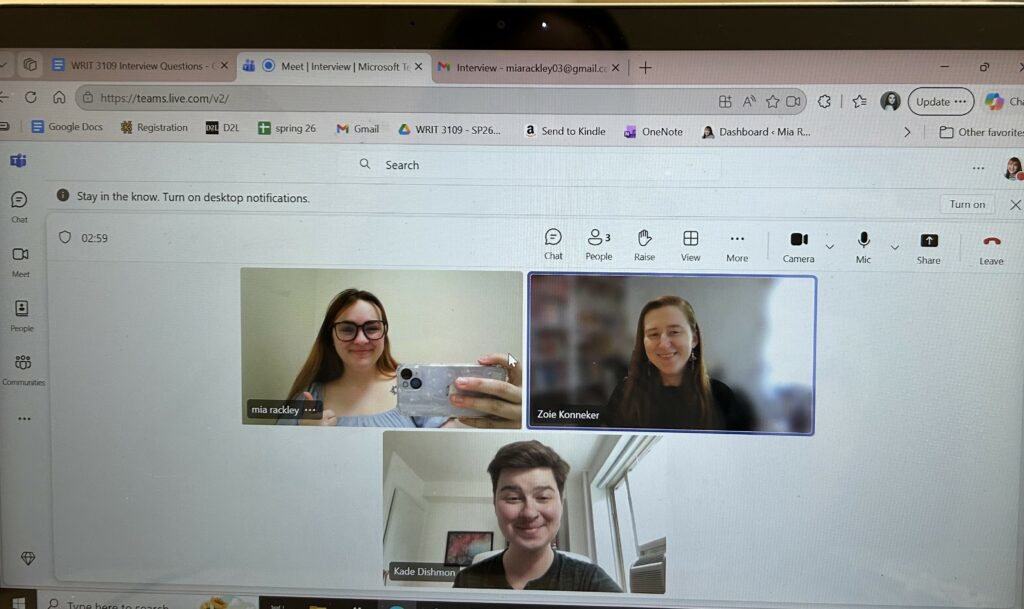
Recently, I had the pleasure and privilege of speaking with Peachtree Teen’s Assistant Editors Zoie Konneker and Kade Dishmon. It was an eye-opening and wonderfully pleasant experience. These are two people who care so deeply not just about their jobs, but about using their careers to make a difference.
Zoie Konneker is a Georgia Tech grad serving as an Assistant Editor at Peachtree Teen. She has been working for the company since 2021, starting out as an Editorial Intern and making her way up to Assistant Editor. She acquires picture books, middle-grade fiction, and young-adult fiction. Kade Dishmon works for the New York City offices of Peachtree Publishing. Dishmon explained that, while he and Konneker work for the same company, because of how Walker Books Group operates, he is based in New York, and Konneker is based in Atlanta. Dishmon started off as an Editorial Assistant and, after about two years and having acquired two novels, was promoted to Assistant Editor. They acquire middle-grade fiction and young-adult fiction. The Peachtree Teen staff consists of four editors, including Konneker and Dishmon.
I started our conversation by asking them a bit about their journeys to where they are in their careers. As a college senior who has followed Peachtree Publishing for a while, I found this especially interesting and helpful to hear about. They both went into their education and explained how they got to their current positions. They also spoke a bit about the difference between Editorial Assistants and Assistant Editors. Very different jobs with very similar titles. Konneker phrased it as “An Editorial Assistant assists the Editorial department”. This job is mostly admin work: sending reminders and emails, making sure everyone stays on track with schedules, and the like. An Assistant Editor is “the first step to becoming an editor”. This position includes taking on your own projects and deciding what books the publisher acquires. Dishmon chimed in and noted that distinguishing the different positions can be made simpler if you think of the word assistant in different ways. In “Editorial Assistant,” the word “assistant” is a noun, and in “Assistant Editor,” the word “assistant” is an adjective.
We spoke a bit about what the big picture and day-to-day operations of the job look like. They both stated that the “Big Picture” of the job is to ensure that a book is the best it can be. The day-to-day outlook was more in-depth. They said the job was mostly reading submissions, administrative work, meeting with agents and potential authors, tracking payments, preparing presentations and sales pitches, collaboration and delegation, and a lot of emailing. Konneker joked that her job feels like 50-60% emailing and 40-50% editing.
We talked a lot about the passion for the job. Publishing, in particular, is a passion-rooted industry by nature, and while it is a lot of hard, repetitive work, it can also be very fulfilling and emotionally rewarding. Dishmon noted specifically that mailing an author’s first print of their first book is an incredibly fulfilling experience, considering how excited that person must be to open that package.
“Ask questions! Be curious! […] We want someone to care!”
Zoie Konneker
Both Konneker and Dishmon spoke about their deep passions for children’s lit and uplifting underrepresented voices. Dishmon shared that when he reads something that he knows would not have been published when he was a child, over the course of time when he was in high school to now, “That breath of representation, and the ability to not just include topics or identities, but to really handle those experiences in a nuanced, complex, and fully human way; it’s something that we do owe, not just to the tireless persistence of these creators who have continued to tell their stories even despite pushback, but all of the individual people who have worked on bringing those stories into the world.” When asked what drew the two of them to Peachtree as opposed to other publishing houses, Dishmon also noted that the company is a groundbreaking imprint that has its finger on the pulse of untold stories, and is combining that commercial hook with real emotional distinction and diverse representation. Both Konneker and Dishmon share a feeling of personal responsibility to bring stories with underrepresented voices into the light.
I posed the question of what they think the strengths are of a smaller staff divided into two cross-country locations, as opposed to a larger publishing house with a larger staff. Konneker stated that the aftermath of the pandemic has affected this, as virtual professional communication has been game-changing with regard to telecommuting over the past six years. They did say that being virtual does change the general work culture, noting that they can’t just walk over to each other’s desks to talk; they have to use Microsoft Teams or text. Having a larger staff would be a little more difficult to navigate, especially in this age of virtual work. Having such a small staff makes it easier to be judicious and get things done as a team, and to communicate more smoothly and simply.
To close out the interview, I asked them both if they had any advice for an aspiring editor. Dishmon’s advice was, “You don’t need to wait around for permission; if you want to work on a project, ask,” and then shared some advice they were given when they were first starting out. “You’re never going to get promoted for making a PowerPoint, because that’s just an essential part of the job description. And so to transcend that assistant role, you have to proactively do things that transcend that assistant role.” Konneker added, “Ask questions! Be curious!” and “You will find that editors are very excited to talk about their projects. We want someone to care!”
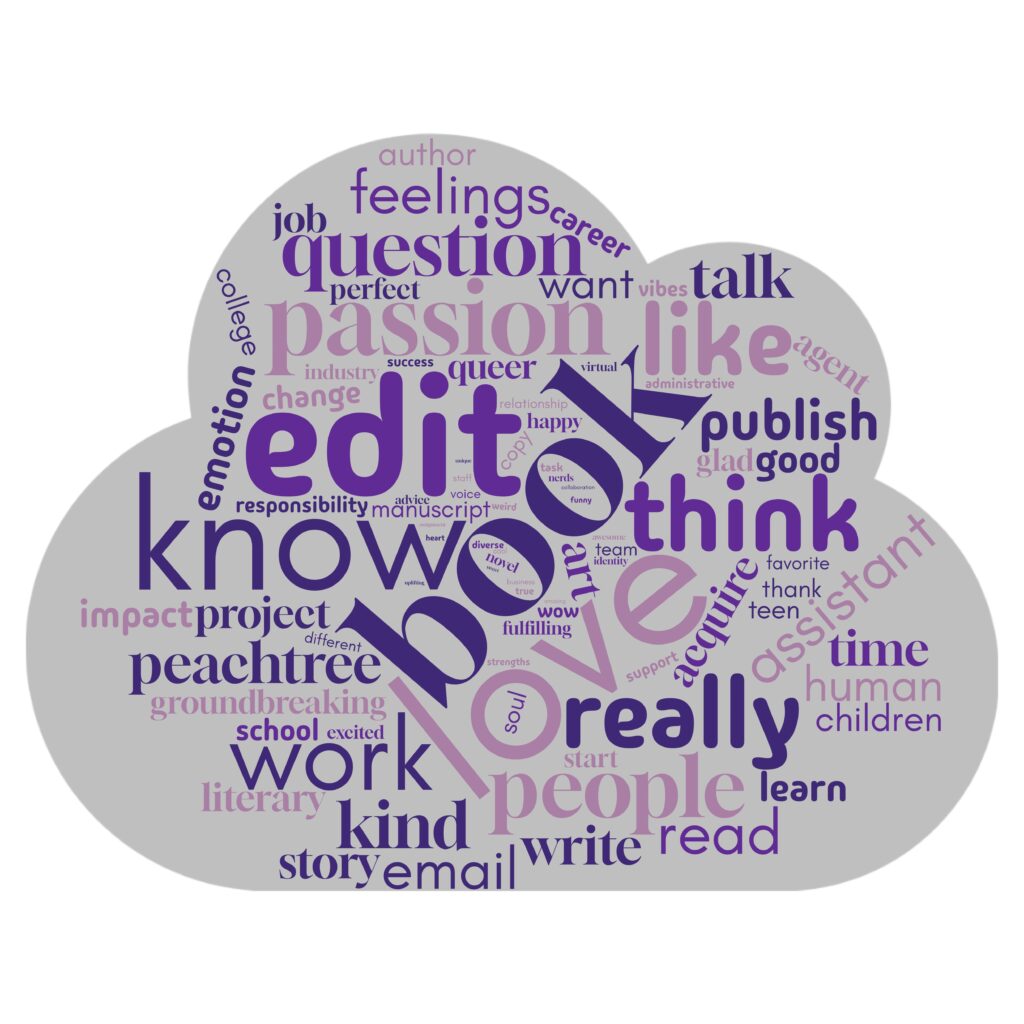
I decided to create a word cloud of the most common words from the interview transcript. I think this just reiterates how passionate these two are about the work that they are doing. Words like “love”, “passion”, and “art” can be seen big and bold. They had a couple of projects that they were so excited to get a chance to talk about, which was really exciting to get to see.
Konneker ended our conversation with a simple “Thank you for giving us a chance to talk about what we love,” which I think perfectly sums up our conversation. I left that interaction even more excited about publishing than I already was, and a lot more confident about what goes into the job as a whole. I am very grateful that the two of them took the time out of their busy days to talk with me; they were fantastic to speak to.