

This is taken from my Linguistics for Education midterm. The assignment was to relate linguistic terms to something that I have an ecosystem of knowledge on. I chose The Hunger Games. For the assignment, we were told not to include definitions of each term. The professor stated that she knows the definitions, and so do we. The assignment was more about using that knowledge and relating it to something to show understanding. To accommodate this, I have included a key at the bottom of the page. Spoilers for The Hunger Games series ahead.
Phonology is the study of the sounds of a language. Phonemes are small sound units (one sound). Each of the twelve remaining districts of Panem, the fictional country in The Hunger Games, is a phenome. The thirteenth district was bombed (deletion). The “career” districts (1, 2, 4) are all different but seem similar to the poorer districts (assimilation). After the first rebellion, referred to as the dark days, the Capitol shifted how it treated the districts. This started the Hunger Games and made borders far more strict (the Great Vowel Shift).
Morphology is the study of word structure. Let’s think of Panem as a sentence as a whole. Morphemes, the smallest meaningful unit of language, are the citizens of Panem. The tributes from the career districts (1, 2, 4) have specialties that help them in the arena (work as a standalone sound, like “a”). District 1 is luxury items, district 2 is weaponry, and district 4 is fishing. These are free morphemes. All of these things can help them win the games with little to no outside training. The poorer districts, such as 12, have no help with the games because they don’t go into the coal mines until after they are no longer eligible. These are bound morphemes. Tributes can bring one thing into the arena with them, a token, as a reminder of home (infix); it cannot be a weapon. Tributes can also form alliances (compounds) to help each other until it’s inevitably time to split off, kill each other, or until everyone else dies. There can only be one winner. However, in the 74th Hunger Games, Katniss and Peeta win together (blending).
Semantics is about the meaning in language. Semantics, in this case, are like a strategy in the arena. Peeta “joined” the career tributes alliance to lead them off of Katniss’s trail, even though he isn’t from one of their districts (semantic broadening). Katniss knew about the nightlock berries and how to use a bow accurately because her father had told her about them when he taught her to hunt (analogical mapping). Peeta used his prior knowledge of icing cakes at the bakery to disguise himself as a rock in a creek while he was hiding/waiting for Katniss (euphemism). There are victors that spent their entire games hiding from the other tributes and just outlasted the others because they didn’t want to kill anyone, and there are victors that ruthlessly killed their opponents without a second thought (antonyms).
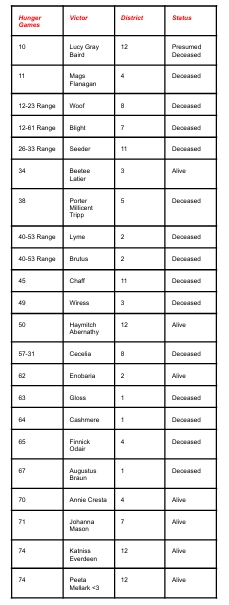
Chart of Victors, when they won, what district they are from, and their status. I typed about 90% of it from memory, fact-checked it afterward, and filled in the blanks. There are a few victors whose specific win years are not confirmed. I actually had to go back and edit this a bit before posting here. This was made before Sunrise on the Reaping came out, and that book confirmed Beetee and Wiress’ win years. It also pretty much confirmed Lucy Gray Baird’s death; there is a grave for her in the woods of District 12, so at the very least, someone made a grave for her in between the events of Ballad of Songbirds and Snakes and Sunrise on the Reaping.
Discourse is how we speak and why it matters. Let’s talk about the rebellion for a moment. The rebellion occurred because of one simple misunderstanding. Katniss pulled out the nightlock berries (locutionary act) because she genuinely didn’t want to leave the arena without Peeta (illocutionary act), but President Snow and a lot of Panem thought it was an act of defiance (perlocutionary act). Plutarch Heavensbee, the head gamemaker of the 75th Hunger Games and a leader of the rebellion, directed a series of propaganda videos. In one of them, they have Finnick, a victor from District 4 and the youngest ever, talk about Snow’s secrets while their soldiers are trying to rescue Peeta from the Capitol (discourse marker).
Syntax is the study of how morphemes and words combine to form phrases and sentences. The living victors of the Hunger Games (parts of speech) work together to help the current tributes win the games, as mentors. So their form is victor, but their function is mentor. Tributes also have an escort, stylists, and prep teams (phrases) that work together as a district team (sentence) to help them get sponsors and win. Haymitch is the only known victor who has to be a mentor on his own (independent clause), as all the other districts have at least two living victors (dependent clauses) to act as mentors.
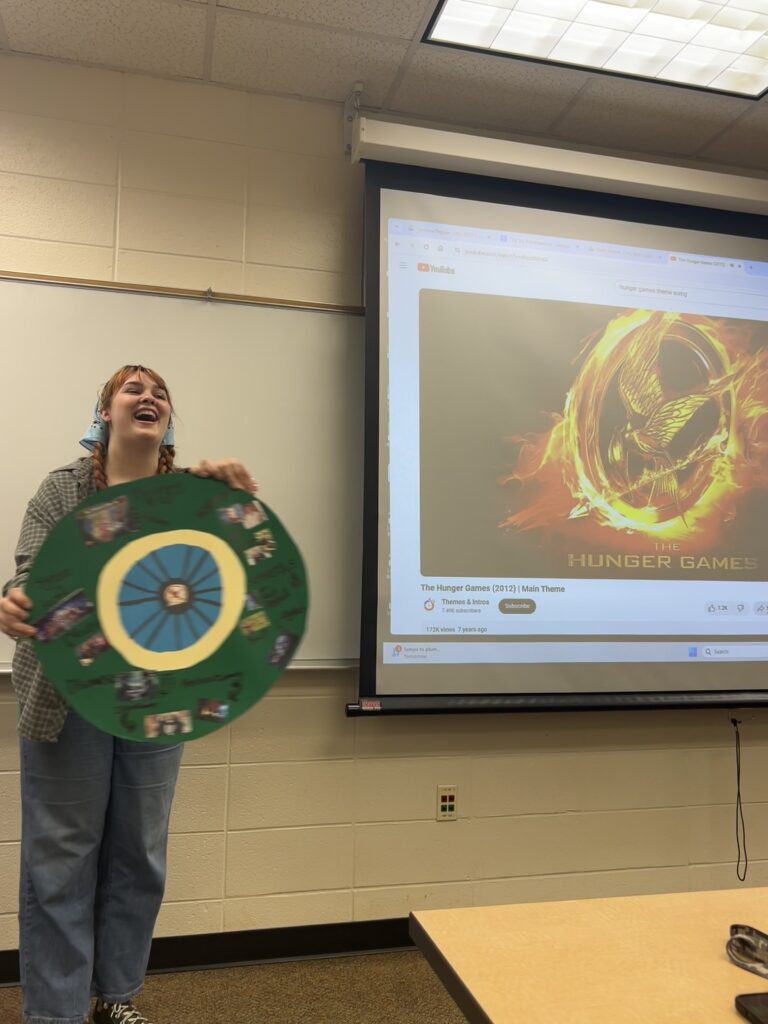
Me, presenting the model that accompanied this paper. I also played music from the soundtrack.
Terms
Deletion: The omission of one or more sounds or segments from a word or phrase, often to simplify pronunciation and enhance fluency in speech.
Assimilation: A sound change in which some phonemes (typically consonants or vowels) change to become more similar to other nearby sounds
The Great Vowel Shift: A series of pronunciation changes in the vowels of the English language that took place primarily between the 1400s and 1600s (the transition period from Middle English to Early Modern English), beginning in southern England and having effectively influenced all dialects of English today.
Free morphemes: Morphemes that are not bound to another, can be used as their own unit.
Bound morphemes: Bound to another morpheme. Cannot stand alone
Infix: An affix inserted inside a word stem
Compounds: A word that is formed by combining two or more stems or words to create a new word with a distinct meaning.
Blending: Combining parts of two or more words to create a new word with its own meaning.
Semantic Broadening: When the meaning of a word or phrase expands to include a broader range of concepts.
Analogical Mapping: Drawing relations among meanings within cognitively based patterns of spatial, temporal, or logical relations.
Euphemism: A mild or indirect word or expression substituted for one that may be considered too harsh or blunt when referring to something unpleasant or embarrassing
Antonym: A word that has the opposite definition to another word
Locutionary Act: The original act, the basic act of speaking.
Illocutionary Act: What the speaker meant by the act
Perlocutionary Act: What the receiver perceived from the act.
Discourse Marker: A word or phrase that helps manage the flow and structure of discourse. This can be indicative of relationships between ideas and guide the listener’s understanding
Parts of Speech: A category to which a word is assigned in accordance with its syntactic functions. In English, the main parts of speech are: noun, pronoun, adjective, verb, adverb, preposition, determiner, conjunction, and interjection.
Phrases: A group of one or more words that function together as a single grammatical unit
Sentence: A word, clause, or phrase, or a group of clauses or phrases forming a syntactic unit which expresses an assertion, a question, a command, a wish, an exclamation, or the performance of an action
Independent Clause: A clause that can stand on its own as a full sentence
Dependent Clause: A clause that cannot stand on its own as a full sentence
to, C. (2021). List of victors. The Hunger Games Wiki; Fandom, Inc. https://thehungergames.fandom.com/wiki/List_of_victors
Curzan, A., & Adams, M. (2012). How English Works: A Linguistic Introduction. Harlow Pearson Education Limited.